



Cities have always been engines of progress. They concentrate talent, capital, culture, and ideas in ways no other human system can. But in the twenty-first century, cities are also under pressure—strained by population growth, aging infrastructure, climate demands, and rising expectations from digitally native citizens. Into this complex reality steps Axurbain, a platform designed for a world where urban growth must be both intelligent and humane.
Axurbain is part of a growing movement redefining how cities are planned, managed, and experienced. Rather than treating urban challenges as isolated problems, it approaches cities as living systems—connected by data, shaped by technology, and ultimately defined by people.
Why Urban Innovation Can’t Wait
More than half of the world’s population already lives in cities, and that number continues to climb. With that growth comes familiar friction: congestion, inefficiency, environmental stress, and unequal access to services. Traditional urban planning methods, often slow and reactive, struggle to keep pace with this change.
Axurbain addresses a critical gap between urban ambition and execution. Smart city initiatives have existed for years, but many failed to deliver meaningful impact because they focused on technology first and outcomes second. Axurbain flips that model by starting with real urban needs—mobility, sustainability, livability—and using digital intelligence as an enabler, not a distraction.
Axurbain as a Digital Layer for Modern Cities
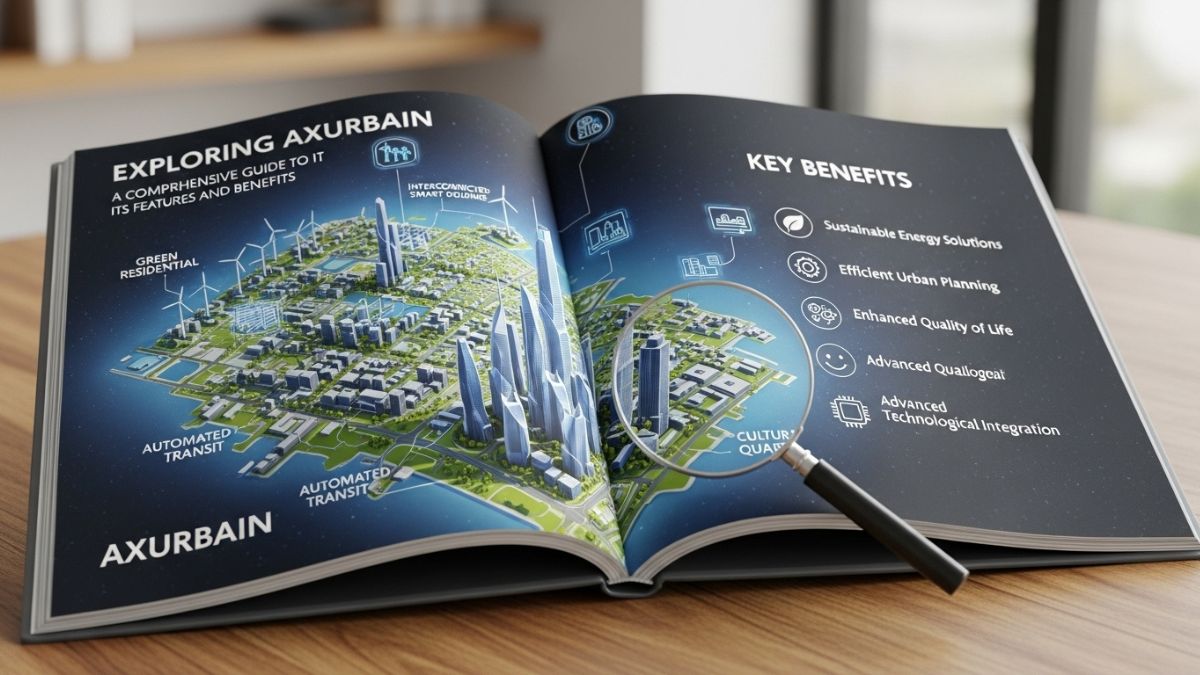
At its core, Axurbain functions as a digital infrastructure layer that helps cities, developers, and planners make better decisions. It integrates data from transportation systems, public services, environmental sensors, and urban design tools to create a unified view of how a city actually operates.
What makes Axurbain compelling is its emphasis on usability. Urban leaders are rarely data scientists. They are policymakers, planners, architects, and operators who need clarity, not complexity. Axurbain translates dense datasets into visual models and actionable insights that support real-world decision-making.
This approach allows stakeholders to simulate outcomes before committing resources—whether redesigning traffic flows, evaluating mixed-use developments, or improving energy efficiency across districts.
The Business Case for Smarter Urban Systems
For entrepreneurs and tech professionals, Axurbain represents more than civic idealism. Cities are among the largest economic platforms in the world. Real estate developers, mobility startups, energy providers, and proptech companies all depend on efficient urban systems to scale.
Axurbain creates opportunities for collaboration between public and private sectors by providing a shared intelligence framework. When everyone works from the same data-driven understanding of the city, innovation accelerates and friction decreases. For startups operating in urban environments, this alignment can dramatically reduce time to deployment and regulatory risk.
Axurbain and Sustainable Urban Growth
Sustainability is no longer a branding exercise; it is a survival requirement. Cities account for a significant share of global emissions, energy use, and resource consumption. Axurbain embeds sustainability metrics directly into urban planning and operational decisions.
Instead of treating sustainability as an afterthought, the platform helps cities model environmental impact alongside economic outcomes. This integrated view enables leaders to make trade-offs transparently, balancing growth with responsibility.
The table below shows how Axurbain supports sustainability across key urban domains:
| Urban Domain | Traditional Challenge | Axurbain’s Contribution |
| Transportation | Congestion and emissions | Data-driven traffic and mobility optimization |
| Energy | Inefficient consumption | Smart monitoring and predictive usage models |
| Housing | Urban sprawl | Compact, mixed-use planning simulations |
| Public Space | Underutilization | Usage analytics and adaptive design |
By grounding sustainability in measurable outcomes, Axurbain helps cities move from aspiration to action.
Human-Centered Design in a Data-Driven World
One of the biggest criticisms of smart city technology is that it can feel cold and impersonal. Axurbain actively counters this perception by prioritizing human-centered design. Technology serves the experience of residents, not the other way around.
By analyzing how people move, gather, and interact within urban spaces, Axurbain enables planners to design cities that feel intuitive and inclusive. Sidewalks, transit hubs, green spaces, and neighborhoods are optimized not just for efficiency, but for quality of life.
This focus resonates with a new generation of urban dwellers who expect cities to adapt to their needs in the same way digital products do.
Axurbain’s Role in Urban Resilience
Recent global disruptions—from pandemics to climate events—have exposed how fragile urban systems can be. Resilience is now a central concern for city leaders. Axurbain supports resilience by enabling scenario planning and real-time monitoring.
Cities can test how infrastructure responds under stress, identify vulnerabilities before they become crises, and coordinate responses across departments. This capability transforms cities from reactive entities into proactive systems that learn and adapt.
For technology professionals, this is where Axurbain’s value becomes especially clear. Resilience is not just about survival; it’s about maintaining continuity in economic and social life when conditions change.
Bridging Policy, Technology, and Execution
Urban innovation often fails at the intersection of policy and execution. Great ideas stall because regulatory frameworks, stakeholder interests, and technical constraints are misaligned. Axurbain acts as a bridge across these domains.
By providing transparent data and shared models, it creates a common language for policymakers, technologists, and investors. Decisions become easier to justify, implement, and measure. Over time, this alignment builds trust—an essential but often overlooked ingredient in urban transformation.
Why Axurbain Matters to Founders and Builders
For startup founders, Axurbain signals where opportunity is heading. Urban technology is no longer niche; it is foundational. From climate tech to mobility platforms, the next wave of innovation will be deeply embedded in city systems.
Axurbain lowers the barrier to entry for innovators by making cities more legible. When urban complexity becomes navigable, experimentation becomes possible. This shift opens the door to faster pilots, smarter partnerships, and scalable solutions.
The Long View: Cities as Platforms
Axurbain reflects a broader idea gaining traction in the tech world: cities as platforms. Just as operating systems enable ecosystems of applications, intelligent urban platforms enable ecosystems of services.
In this model, cities are not static environments but programmable systems. Axurbain provides the intelligence layer that makes this vision practical rather than theoretical. It allows cities to evolve continuously without losing coherence or control.
Conclusion: Axurbain and the Cities We’re Building Next
The future of cities will not be decided by technology alone, nor by policy in isolation. It will be shaped by platforms that integrate data, design, sustainability, and human experience into a single operating vision. Axurbain stands at this intersection.
For entrepreneurs, technologists, and urban leaders, Axurbain offers more than insight—it offers a framework for building cities that work better for everyone. In an era where urban success defines economic and social progress, that mission could not be more relevant.